
· by Michael Blair, Nashville's HVAC
Two service visits a year, cooling in spring and heating in fall, is the schedule ENERGY STAR’s maintenance checklist recommends, partly because contractors get busy once summer and winter arrive. It is also the schedule our maintenance plans are built on. What varies from one company to the next is what actually happens during those visits, and the price on its own will not tell you.
What should a spring cooling visit include?
A real cooling visit means measuring, not just looking. The contractor’s side of that ENERGY STAR checklist includes tightening the electrical connections, measuring voltage and current on the motors, and checking the central air conditioner’s refrigerant level and adjusting it if it is off. We also take the temperature of the air going into the system and the air coming out. Written down each spring, those readings give us last year’s numbers to compare against, and a slow change is far easier to see that way.
Then the cleaning. ENERGY STAR puts both coils on the contractor’s list, the evaporator inside and the condenser outside, and says dirty coils make a system run longer, cost more to run and wear out sooner. The condensate drain is on the same list. While the panel is off we check the contactor and the capacitor too, because a weak part is simpler to replace on a booked April visit than on an AC repair call in July, when contractors are at their busiest.
What should a fall heating visit include?
On gas, ENERGY STAR lists the gas connections, gas pressure, burner combustion and the heat exchanger, plus a check of the controls and the starting cycle so the system starts, runs and shuts off properly. We look at the flame and the venting on the same visit. EPA’s page on carbon monoxide indoors names leaking furnaces, back-drafting from furnaces, and a flue that is blocked or disconnected among the sources of carbon monoxide in a home, and it recommends having a trained professional inspect, clean and tune up the central heating system, flues and chimneys included, every year. That is why the fall visit is the one we would least like a customer to skip. If the first run of the season leaves a burning smell at the vents, our post on the burning smell when the heat first comes on sorts the dust burning off from the smells that mean shut it off. If a technician ever tells you the heat exchanger is cracked, our post on that diagnosis covers what proof to ask for.
On a heat pump, the question is how much the backup heat runs. DOE’s federal buying guidance for air-source heat pumps explains that electric resistance elements are typically added to make up for shortfalls in a heat pump’s heating capacity, and that because they are inefficient their use should be kept to a minimum; it recommends thermostats designed for heat pumps, which bring the temperature up slowly so the elements stay off. We confirm the strips come on when they should and stay off when the compressor can carry the house, and we run the unit through a defrost so we see it work before the first cold snap. What a defrost looks like from the back yard is in our post on why a heat pump steams in winter.
What you can do yourself
Filters come first. The one job ENERGY STAR’s checklist hands to the homeowner is to inspect, clean or change the filter once a month in an air conditioner, furnace or heat pump. Its Ask the Experts piece on keeping a system efficient fills in the practical part: clean a reusable filter, replace a disposable one when it is dirty, point the arrow on the frame toward the furnace or blower, and expect a tight fit. Outside, keep leaves, grass clippings and shrubs back from the condensing unit; the installation manual for your brand says how much room it needs. Coil cleaning sits on ENERGY STAR’s contractor list, and we would leave it there.
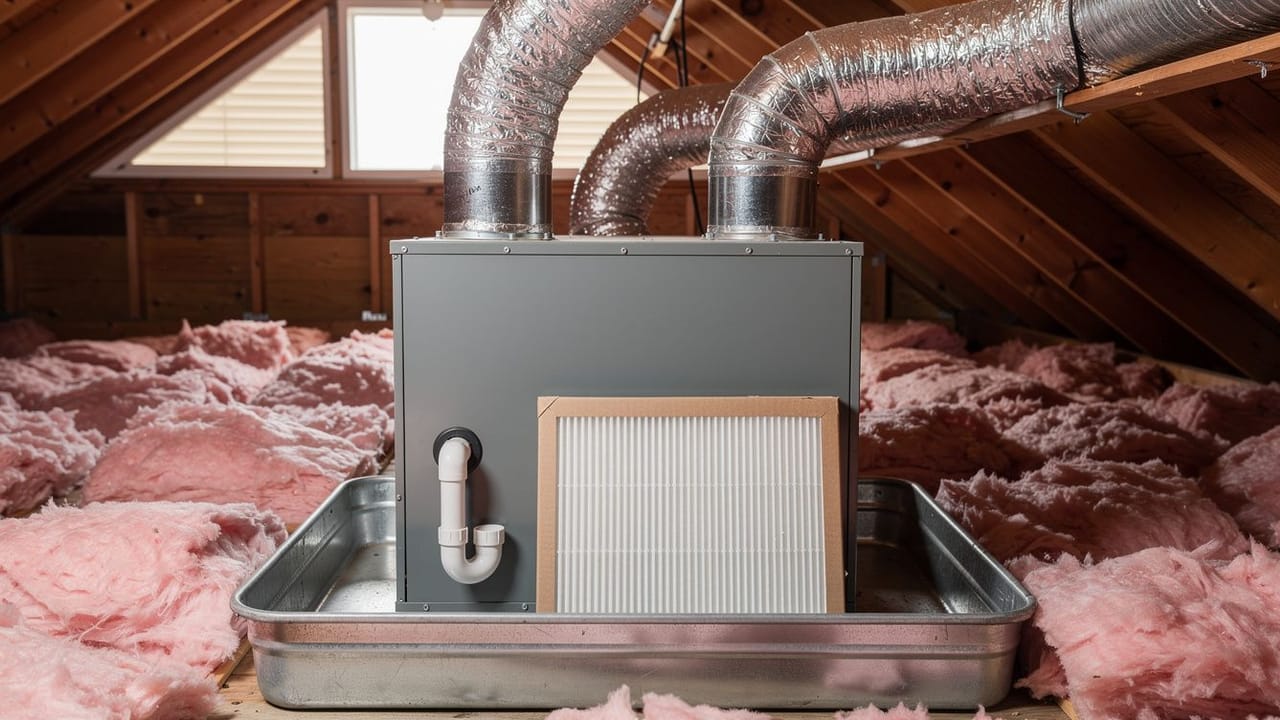
Keep an eye on the drain as well. ENERGY STAR warns that a plugged condensate drain can cause water damage in the house and affect indoor humidity. With an air handler in the attic, that water can show up as a stain on the ceiling below it. If the house feels damp even when the thermostat is satisfied, our post on why a house feels clammy at 72 degrees goes through the other causes.
- Filter: check it monthly, clean or change it when it is dirty
- Arrow on the filter frame pointing toward the blower
- Leaves, clippings and shrubs kept back from the outdoor unit, as far as its manual asks
- Coil cleaning left to the spring visit
- Under an attic air handler, an emergency pan that stays empty, with its float switch tested on each visit
Whether a plan is worth it
Read what is included before comparing prices. A plan that covers two visits with the readings written down is worth having; one that covers a glance and a filter is a filter subscription. Ours is two visits a year, priority scheduling and no diagnostic fee, and the priority part earns its keep in the seasons ENERGY STAR warns are the busy ones.
What the visits protect is the working life of the equipment. In its 2017 efficiency standards for central air conditioners and heat pumps, DOE estimated the average central air conditioner’s life at 18.0 years in its hot-humid region, which includes Tennessee, against 21.2 years nationally, and a heat pump’s at 15.1 years in that same region. For non-weatherized gas furnaces, DOE’s 2022 proposed furnace standards put the average at 21.4 years. Those are modeled averages, and DOE’s purchasing guidance for central air conditioners adds that regular maintenance, such as charging refrigerant and replacing filters, is necessary to keep one at peak performance. To get the spring and fall visits on the calendar, contact us.
Sources
- ENERGY STAR, Maintenance Checklist — Cooling checkup in spring, heating in fall, contractors busy in summer and winter; contractor list: electrical connections, voltage and current on motors, refrigerant level, both coils, condensate drain, gas connections, gas pressure, burner combustion, heat exchanger, controls and starting cycle; homeowner checks the filter monthly; dirty coils shorten equipment life; a plugged drain can cause water damage and affect humidity
- ENERGY STAR, How to keep your HVAC system working efficiently — Check the filter once a month, clean a reusable one or replace a dirty one, arrow toward the furnace or blower, tight fit
- U.S. EPA, Carbon Monoxide’s Impact on Indoor Air Quality — Leaking furnaces, back-drafting and blocked or disconnected flues as carbon monoxide sources; have a trained professional inspect, clean and tune up the central heating system annually
- U.S. Department of Energy, FEMP, Purchasing Energy-Efficient Residential Air-Source Heat Pumps — Electric resistance elements make up heating capacity, are inefficient and should be kept to a minimum; heat pump thermostats that ramp slowly to keep them off
- U.S. Department of Energy, Energy Conservation Standards for Residential Central Air Conditioners and Heat Pumps, direct final rule (Federal Register, January 6, 2017) — Table IV-16 average lifetimes: central air conditioners 21.2 years national, 18.0 hot-humid; heat pumps 15.1 hot-humid; the hot-humid region includes Tennessee
- U.S. Department of Energy, Energy Conservation Standards for Consumer Furnaces, proposed rule (Federal Register, July 7, 2022) — Average lifetime of non-weatherized gas furnaces estimated at 21.4 years
- U.S. Department of Energy, FEMP, Purchasing Energy-Efficient Residential Central Air Conditioners — Regular maintenance, such as charging refrigerant and replacing filters, is necessary to maintain peak performance
FAQ
What HVAC Maintenance Actually Needs Doing — questions
Is an annual AC tune-up actually worth it?
Yes, mostly for what it catches early. A weak capacitor, a worn contactor or a condensate drain that is starting to clog can be dealt with on a scheduled spring visit instead of a no-cooling call in July. ENERGY STAR notes that dirty coils make a system run longer and shorten its life, and that a plugged drain can cause water damage. We have not seen a reliable figure for how much efficiency a tune-up adds, so we make the case on the breakdowns it heads off.
How long should an HVAC system last in Nashville?
DOE estimates the average central air conditioner lasts about 18 years in the hot-humid region that includes Tennessee, compared with about 21 years nationally, and a heat pump about 15 years. Its estimate for a gas furnace is about 21 years nationally. Those are averages from DOE’s efficiency rulemaking, so a given system can fall short of them or outlast them. ENERGY STAR says dirty filters and dirty coils shorten equipment life, which is the part an owner controls.
What is the most common HVAC failure in summer here?
We have not found a published count of summer failures for Middle Tennessee, so we will not rank them. What a spring visit checks is the list ENERGY STAR gives contractors: electrical connections and motor current, refrigerant level, dirty coils and the condensate drain, and we test the capacitor and contactor as well. Any one of them can leave a house without cooling on a hot day, which is the practical argument for the visit.
What HVAC maintenance can a homeowner do?
Mostly the filter: check it monthly, clean a reusable one or replace a dirty disposable one, point the arrow on its frame toward the blower, and make sure it fits tightly. Keep leaves, clippings and shrubs back from the outdoor unit, and watch the condensate drain, since a plug can cause water damage. Leave coil cleaning to the spring visit.