· by Michael Blair, Nashville's HVAC
The first cold night of the fall is when a gas furnace that sat idle all summer gets asked to work, and it is when the calls start: the thermostat is set to heat, the house keeps getting colder, and the furnace either does nothing or lights for a few seconds and goes quiet. Some of those come down to a switch or a filter you can handle yourself. Others are the furnace shutting itself down to protect the people inside, and those should not be reset over and over, jumpered or ignored. Here is how to tell which one you have, what each behavior points to inside the cabinet, and when it is time for our furnace repair crews.
What you can check yourself first
The owner’s manual for a typical condensing gas furnace lists what to rule out before a service call, and it is a short list. Payne’s condensing furnace owner’s manual has you confirm the thermostat is in HEAT and set above the room temperature, the breakers and the furnace power switch are on, the manual gas valve is open, and the vent outside is not blocked. The same manual is plain about where homeowner work stops: cleaning and replacing filters is fine, and everything else belongs to trained service people.
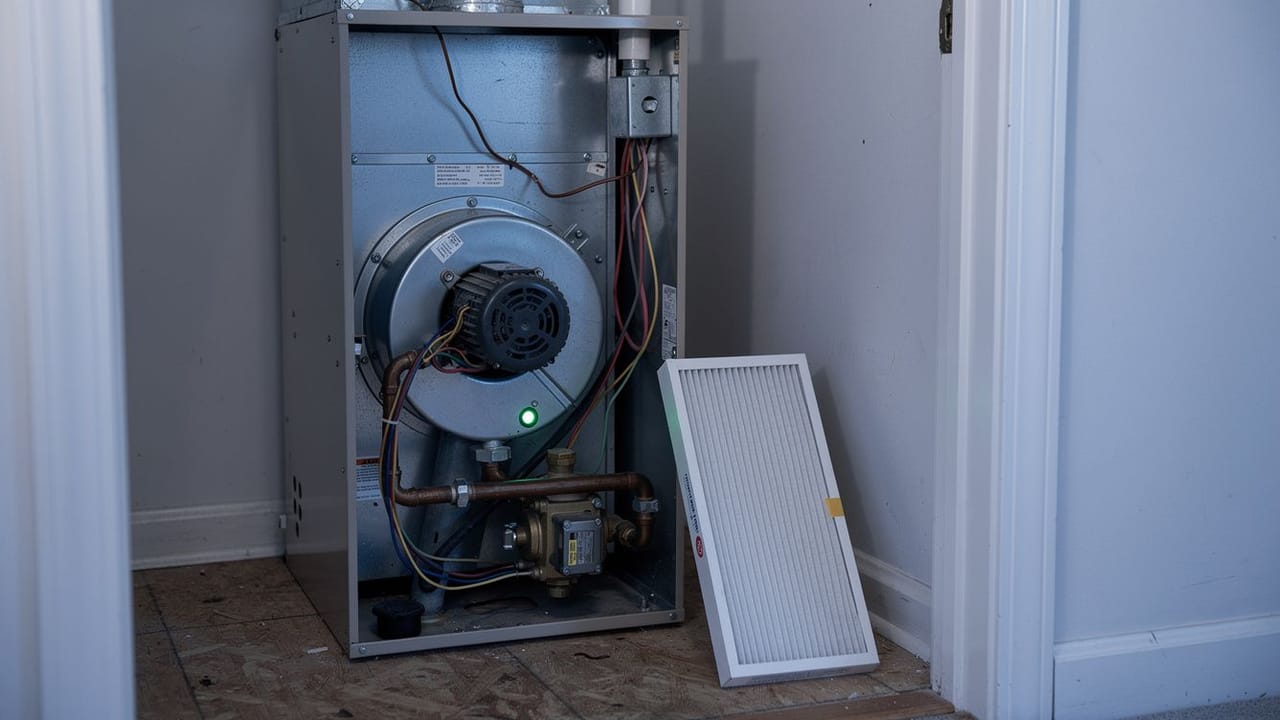
Two of those checks catch people out. A tripped breaker often sits in the middle rather than all the way off, and Carrier’s page on a furnace not turning on says to push it fully off and then back on. The furnace power switch usually looks like an ordinary light switch on the wall or ceiling near the unit, and it gets flipped off by someone reaching for the closet light. Before you cut power to anything, look through the small window in the furnace door for a blinking light and write down the pattern; the manual asks for that code, and it tells a technician where to start.
Then pull the filter. Payne’s manual notes that a dirty filter can make the furnace overheat and shut itself down. On a high-efficiency furnace, also look for water. These units make condensate, and as standard trade practice many carry a float switch in the drain pan or drain line that cuts the furnace off when the drain backs up, so a full pan or a clogged line will stop the heat until the water has somewhere to go.
- Thermostat in HEAT and set above the room temperature
- Breaker fully on, reset from off if it sits in the middle
- Furnace power switch on and the door panel fully seated
- Filter clean, or replaced
- Status light code written down before power is cut
- Vent outside clear of leaves and nests
What the furnace is telling you when it tries
A gas furnace starts in a fixed order, and where it stops is the best clue to what failed. The thermostat calls for heat, the draft inducer motor starts pulling air through the burners and out the flue, a pressure switch confirms that draft, the ignitor glows, the gas valve opens, and a flame sensor confirms there is fire before the main blower comes on. Carrier’s furnace troubleshooting page ties the symptoms to that sequence: an inducer that runs while the burners never light points to an ignition or pressure switch problem, and a blower running with no fire points to the ignitor or the flame sensor.
If you hear the inducer hum and nothing else, the pressure switch is the usual suspect. Carrier’s technician troubleshooting guide lists obstructed tubing, a stuck switch and a blocked vent as the causes. If the ignitor never glows, a hot surface ignitor may have cracked or simply worn out; they are brittle parts. Neither is something a homeowner should handle, and replacing a pressure switch without finding out why it did not close only hides a venting problem.
The furnace that lights, burns a few seconds and shuts off is the classic flame sensor case. The sensor is a thin metal rod that sits in the flame, and the same Carrier guide names oxide on the rod, along with low gas pressure and a bad ignitor, among the reasons the flame is not proved. When that happens the control tries again a few more times and then locks out; on the Carrier furnaces that guide covers, the lockout clears on its own after three hours or when power is interrupted. Trane’s page on burners that shut off after ignition adds a clogged filter tripping the limit switch, dirty burners and a failing control board, and says most of these need a professional.
The shutdowns you should never bypass
Two switches exist only to stop a furnace from hurting someone. The high limit switch opens when the heat exchanger runs too hot, most often because too little air is moving across it, and it closes again on its own once things cool. The flame rollout switch sits by the burners and opens when flame rolls out of the burner area instead of going into the heat exchanger. Many rollout switches have a manual reset button, and the Payne owner’s manual allows one push of it; if it trips again, shut the furnace down and call for service.
Lennox’s explanation of the flame rollout switch lists what makes one trip: a cracked heat exchanger, dirty burners, a blocked flue, and gas pressure or inducer problems. Each of those can put carbon monoxide into the house, which is why Lennox says repeated trips call for a technician rather than the reset button, and why Carrier’s troubleshooting guide says in capital letters not to bypass the switch, and to correct the combustion air, the failed part or the restricted flue before resetting. A jumper wire across a limit or rollout switch gets the heat back on and takes away the one thing standing between a fault and the living room.
If a rollout trip leads to a heat exchanger diagnosis, read what to ask for when a furnace is called cracked before agreeing to a replacement. A photograph of the crack is worth more than any reading taken on its own.
Carbon monoxide, and when to call
The EPA’s page on carbon monoxide names poorly maintained furnaces, blocked flues and back-drafting among the household sources of the gas, and a furnace tripping its safety switches is often showing exactly those faults. You cannot see or smell carbon monoxide. The Consumer Product Safety Commission recommends an alarm on every level of the home and outside sleeping areas, and lists the early symptoms as headache, dizziness, weakness, nausea, vomiting and confusion, which are easy to blame on a cold.
If a carbon monoxide alarm goes off, or you smell rotten eggs near the furnace or the gas line, do not try another reset. Carrier’s advice is to get everyone out of the house, and the CPSC says to get to fresh air and call 911. Leave the furnace to the fire department and the gas utility.
Call us when the simple checks are done and the furnace still will not run, when it locks out more than once, when the rollout switch has tripped, or when the status light shows a code you cannot read. Our crews cover Middle Tennessee, including HVAC service in Brentwood and the rest of Williamson County. Tell us what the furnace did, what the light was blinking and what you already checked, and ask for a free estimate.
Sources
- Payne, Owner’s Manual, Condensing Gas Furnace (2018) — The homeowner checklist before a service call, the single rollout reset, filter-caused overheating shutdowns, and that only filter work is for untrained people.
- Carrier, Troubleshooting Guide, Deluxe 2-Stage Gas Furnaces — Ignition retries and lockout, flame-proving failure causes, pressure switch faults, and the instruction not to bypass the limit or rollout switch.
- Carrier, Furnace Not Turning On? — Symptoms tied to ignition and pressure switch faults, resetting a breaker tripped to the middle, and evacuating on a gas smell or CO alarm.
- Lennox, Flame Rollout Switch — What trips a rollout switch, that repeated trips need a technician, and not to bypass it.
- Trane, Furnace Main Burner Shuts Off After Ignition — Causes of a furnace that lights and then drops out.
- U.S. EPA, What Is Carbon Monoxide — Poorly maintained furnaces, flue blockage and back-drafting as household CO sources.
- U.S. Consumer Product Safety Commission, Carbon Monoxide Information Center — Alarm placement, symptoms of CO poisoning, and getting to fresh air and calling 911.