
· by Michael Blair, Nashville's HVAC
A new furnace that heats the house by evening has been installed, but not necessarily installed right. A gas furnace comes with an installation manual that the installer is expected to follow, and much of what it asks for happens after the unit is in place: testing the gas piping, getting combustion air and the condensate drain right, and setting the furnace up against its own rating plate. This is what one manufacturer’s manual lays out, what Energy Star says to ask for, and what we do on a furnace and system replacement in Nashville, Smyrna and the rest of our area.
What happens on the day a new furnace is installed?
The old unit comes out, the new one goes in, and then it gets connected to gas, venting, air, drain and power and tested against its manual. The example we use here is Carrier’s installation, start-up and operating instructions for the 58MSA condensing gas furnace, one model’s manual rather than a rule for every furnace, but it shows what a manufacturer expects.
Gas piping is the first item that matters to safety. The manual says the piping must meet national and local codes, including the current National Fuel Gas Code, and it is blunt about testing it: check joints for leaks with a soap-and-water solution, never with a match or open flame, and never purge a gas line into the combustion chamber.
Combustion air comes next. The manual gives sizes for the openings that bring outdoor air to a furnace in a confined space: at least one square inch of free area for every 4,000 Btu per hour of total input when the air comes through vertical ducts, and one square inch for every 2,000 Btu per hour through horizontal ducts. A furnace moved into a smaller closet than the old one sat in may need its air supply rethought.
Why does a high-efficiency furnace need a drain?
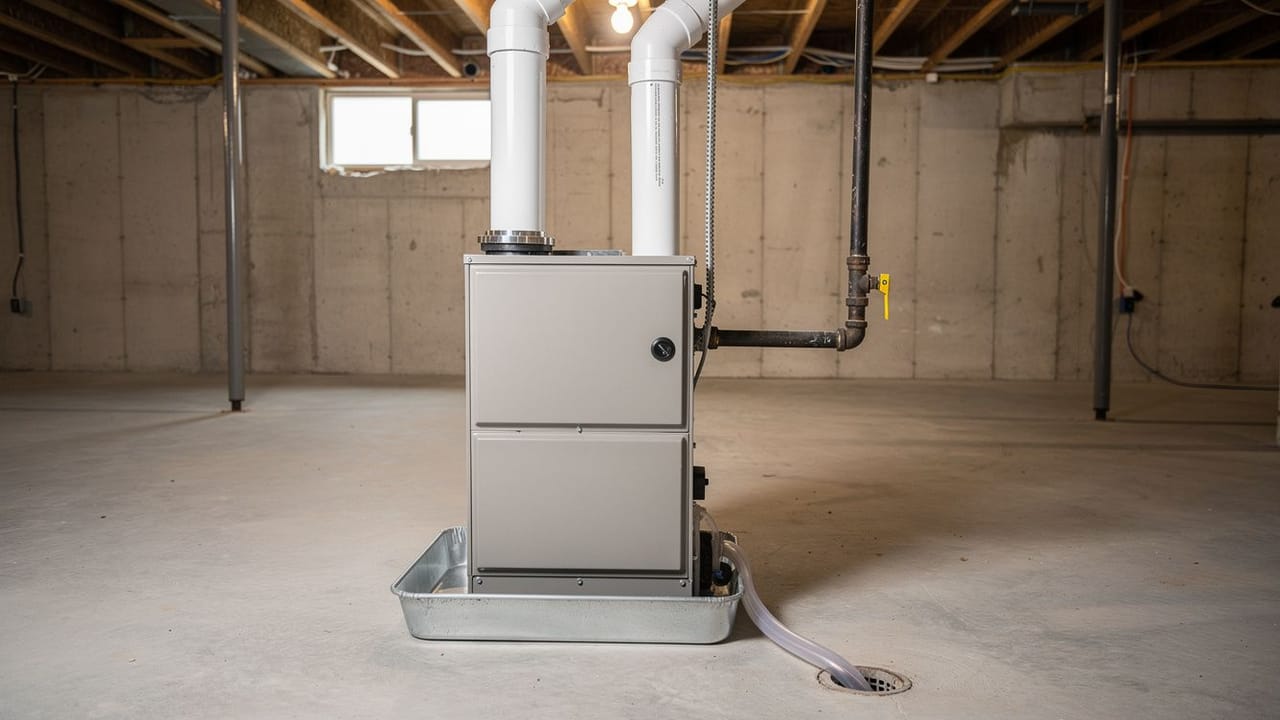
A condensing furnace pulls enough heat out of its exhaust that water condenses inside it, and that water has to go somewhere. The Carrier manual has the installer prime the condensate trap with water before start-up, says the trap must sit below the furnace, and says the drain connection must be properly sloped to an open drain. Its installation checklist also calls for the external drain connection to be leak-tight and sloped, and for internal tubing to be free of kinks.
It also warns that local codes may require a drain pan under the entire furnace. That matters most when the furnace is in an attic or above a finished room, where an overflow ends up in the ceiling. Where the trap or drain line could freeze, the manual describes freeze protection for both, because frozen condensate can crack them.
What should I see done when my furnace is installed?
Measured numbers, not just warm air from the vents. The Carrier manual’s start-up checklist includes setting the gas input rate within 2 percent of the rating plate and adjusting temperature rise, and its installation checklist starts with the heating and cooling load calculations behind the furnace size.
- Temperature rise. The installer puts thermometers in the return and supply ducts close to the furnace and subtracts one reading from the other. The manual says the result must fall within the range on the rating plate, recommends running at the midpoint or above, and warns that operating outside it can cause condensing in or overheating of the heat exchanger. Blower speed sets it: faster lowers the rise, slower raises it.
- Gas input. The checklist calls for input set within 2 percent of the rating plate, which the manual has the installer check by timing the gas meter.
- Sizing. Energy Star’s quality installation guidance says to ask the contractor to size equipment from the actual characteristics of your home, not a rule of thumb, and warns that oversized equipment cycles on and off too often, costing comfort and equipment life.
- Airflow. Energy Star also says poor airflow cuts efficiency and comfort. If the ducts are part of the problem, our post on new ductwork sizing, sealing and insulation goes through that work.
Permits, paperwork and the walk-through
Gas and mechanical work in Davidson County runs through Metro Codes. Its trade permits page lists gas and mechanical trade permits, says only licensed contractors with an e-permit account can apply online, and says everyone else applies in person at the Department of Codes and Building Safety. Ask your installer which permit the job is under. Outside Davidson County, the city or county where you live sets its own process.
Before the crew leaves, ask them to show you the gas shutoff, the filter and how it comes out, where the condensate drain ends, and the temperature rise they measured against the range on the plate. If you are still choosing between fuels, our post on a heat pump versus a gas furnace covers that decision, and if the old furnace is on its way out, contact us and we will look at it with you.
Sources
- Carrier, 58MSA Condensing Gas Furnace: Installation, Start-Up and Operating Instructions — National Fuel Gas Code; soap-and-water leak check, never a flame, never purge into the combustion chamber; combustion air opening sizes by duct direction; condensate trap below the furnace, primed, sloped to an open drain; drain pan per local code; gas input within 2 percent of the rating plate; temperature rise within the plate range, midpoint or above, set by blower speed; installation and start-up checklists
- ENERGY STAR, HVAC Quality Installation — Size from the home’s actual characteristics, not a rule of thumb; oversized equipment cycles too often; poor airflow cuts efficiency and comfort
- Metro Nashville Codes, Trades Permits — Gas and mechanical trade permits; online applications only for licensed contractors with an e-permit account; others apply at the Department of Codes and Building Safety
FAQ
Gas Furnace Installation: What the Manual Requires — questions
What should an installer check after installing a new furnace?
Gas joints with soap and water, the combustion air supply, the condensate trap and drain on a high-efficiency unit, the gas input rate against the rating plate, and the temperature rise across the furnace. One Carrier manual puts gas input within 2 percent of the plate and temperature rise within the plate’s range.
Does a furnace installation need a gas leak test?
Yes. The Carrier installation manual we cite says to check gas piping for leaks with a soap-and-water solution, never with a match or open flame, and never to purge a gas line into the combustion chamber. The piping itself has to meet the National Fuel Gas Code and local codes.
Should my installer measure temperature rise on a new furnace?
Yes. The manual has the installer read thermometers in the supply and return ducts near the furnace and subtract one from the other. The result must fall within the rating plate’s range, ideally at the midpoint or above, and is adjusted with blower speed. Too far outside it can harm the heat exchanger.
Why does a high-efficiency furnace have a drain line?
A condensing furnace takes so much heat from its exhaust that water condenses inside it. The Carrier manual calls for a condensate trap below the furnace, primed before start-up, and a drain sloped to an open drain. Local codes may also require a drain pan under the whole unit.
What does a furnace installer do before leaving?
At minimum, test the gas piping for leaks, confirm the condensate drain runs, set gas input and temperature rise against the rating plate, and check the safety controls, which is how one manufacturer’s start-up checklist runs. Ask them to show you the readings, the filter and the gas shutoff.