
· by Michael Blair, Nashville's HVAC
A heat pump’s efficiency rating describes the equipment in a lab, not the system in your house. What it delivers on a cold January morning in Middle Tennessee depends on how it was sized, piped, charged and set up, and the Department of Energy’s own guidance says installation faults are common. Here is what a proper system replacement with a heat pump includes, step by step, and what you can ask your installer to show you.
How is a heat pump sized for a house?
A heat pump is sized from a load calculation of the house itself, not from the tonnage of the old unit or a rule of thumb per square foot. The 2018 International Residential Code as adopted in Tennessee, Section M1401.3, says heating and cooling equipment shall be sized under ACCA Manual S, based on loads calculated with ACCA Manual J or another approved method. Tennessee’s residential energy code, the 2018 IECC, Section R403.7, repeats the requirement.
The Department of Energy’s heat pump replacement checklist is more specific about how: a room-by-room Manual J, then an ENERGY STAR certified heat pump selected under Manual S from those results. Room by room matters because it shows which rooms the ducts are short-changing.
A heat pump that is too big for the house tends to cool in short bursts and leave humidity behind, which our post on short cycling covers. Here it also has to carry the heating load, which is why our post on heat pumps against gas furnaces spends so long on the coldest nights.
What should happen to the ducts and refrigerant lines?
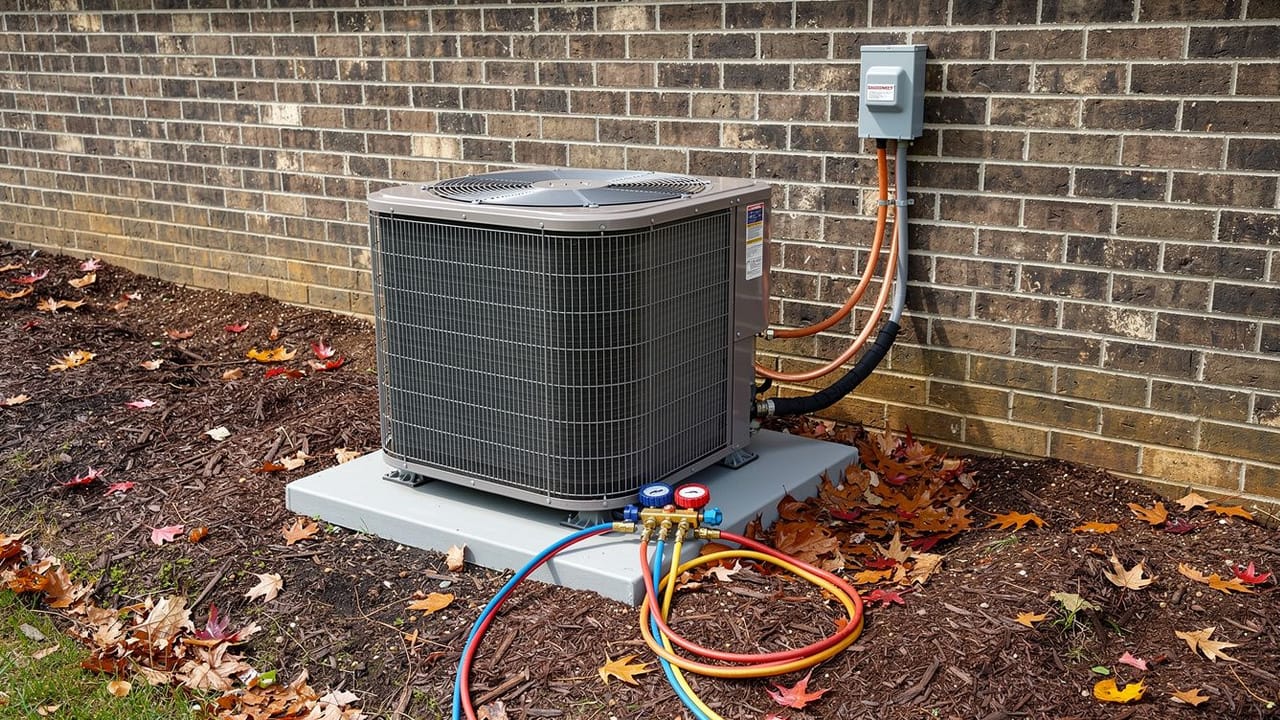
The ducts get inspected and sealed, and the refrigerant lines get tested for leaks before any refrigerant goes in. The DOE checklist asks the installer to look over every exposed duct, repair or replace any that are damaged or disconnected, and seal visible leaks with UL 181 tape or mastic, then check whether supply and return airflow are balanced and the ducts properly sized, with recommendations to the homeowner if they are not.
For the lines, the Building America Solution Center’s guide to heat pump installation and commissioning describes two tests. A nitrogen pressure test holds the piping at a typical residential 250 to 600 PSIG for 30 to 60 minutes, with the manufacturer’s values taking precedence and field joints bubble-tested. Then a vacuum decay test pulls the system below 500 microns and watches it for at least ten minutes; it passes when the reading rises less than about 50 microns and stays under 500.
Only then is the refrigerant released or added. For a new installation the guide lists weighing in the charge, alongside the superheat method for fixed-orifice systems and subcooling for those with an expansion valve, and it says the manufacturer’s procedure takes precedence. Any leak is fixed before the charge is finalized.
How do you know a heat pump was installed right?
You know a heat pump was installed right when the installer measured it running and wrote the numbers down. The Building America guide calls this commissioning: airflow measured and compared with the manufacturer’s range, total external static pressure read at the return and supply, the charge verified, and the controls tested. It cites DOE research finding that 70 to 90 percent of air conditioners and heat pumps have at least one installation or maintenance fault that hurts performance, and studies from the National Institute of Standards and Technology showing a 15 percent airflow shortfall or a 20 percent undercharge is enough to waste energy noticeably.
The DOE checklist adds the details a homeowner can see. Airflow across the indoor coil should land inside the manufacturer’s CFM range under ANSI/ACCA Standard 5, rooms should be balanced with a pressure pan or flow hood, the filter should be MERV 8 or higher without choking the coil, and a filter rack on the air handler should have a gasketed access panel. A new thermostat belongs on an interior wall away from registers, drafts and sun.
Outdoors and at the air handler, the code adds a few fixed points. The outdoor unit must be listed for outdoor use and set on supports that keep it from vibrating, settling or moving, and the refrigerant ports need locking tamper-resistant caps. Condensate drains need a slope of at least 1 percent, and an air handler in an attic needs a secondary drain or pan where an overflow could damage the ceiling below.
What keeps the backup heat from running up the bill?
The controls keep the backup heat from running up the bill, and Tennessee’s energy code requires them. Section R403.1.2 of the 2018 IECC says a heat pump with electric resistance backup must have controls that keep the backup off whenever the heat pump alone can meet the heating load, except during defrost. The Building America guide puts it in terms of the balance point: the backup should run only below the outdoor temperature at which the heat pump can no longer keep up.
In practice that is a thermostat set up for a heat pump, with the auxiliary stage and any outdoor lockout configured during commissioning rather than left at a default. A system that leans on its strips every cold morning will show it on the power bill long before anything breaks, which our post on heat pump defrost and winter operation goes into.
When we quote a heat pump in Brentwood or anywhere in Middle Tennessee, the load calculation, the line tests, the charge and airflow readings and the thermostat settings are part of the job and part of the paperwork you get. If you are weighing a replacement, ask us for a load calculation and a quote.
Sources
- International Residential Code 2018, Chapter 14, Sections M1401.3, M1401.4, M1411 (Tennessee state-adopted edition, UpCodes) — Equipment sized under ACCA Manual S from Manual J loads; outdoor equipment listed for outdoor use on stable supports; locking refrigerant port caps; condensate slope and secondary drains
- Tennessee Residential Energy Code 2018 (IECC 2018), Sections R403.1.2 and R403.7 (UpCodes) — Controls that keep supplementary electric heat off when the heat pump can meet the load, except during defrost; equipment sizing under Manual S and Manual J
- U.S. Department of Energy, Building America Solution Center (PNNL), Heat Pump Replacement Checklist — Room-by-room Manual J; ENERGY STAR equipment sized under Manual S; duct inspection and sealing with UL 181 tape or mastic; ANSI/ACCA Standard 5; MERV 8 filter and gasketed access; thermostat location; charge, balance and coil airflow verified
- U.S. Department of Energy, Building America Solution Center (PNNL), Heat Pump Quality Installation and Commissioning — Nitrogen pressure and vacuum decay tests; charging methods; airflow and static pressure; backup heat only below the balance point; 70 to 90 percent of systems with a fault; NIST airflow and undercharge findings
FAQ
Heat Pump Installation: What a Proper Job Includes — questions
How is a heat pump installed step by step?
A Manual J load calculation comes first, then equipment sized under Manual S. The ducts are inspected and sealed, the outdoor unit is set on a stable pad, and the refrigerant lines are pressure-tested with nitrogen and pulled into a deep vacuum. The charge is set by the manufacturer’s method, then airflow and controls are measured and adjusted.
What size heat pump do I need for my house?
Only a load calculation can tell you. Tennessee’s adopted residential and energy codes require equipment sized under ACCA Manual S from loads calculated with Manual J or another approved method, and the Department of Energy’s checklist asks for that calculation room by room. The old unit’s size and square-foot rules of thumb are not a substitute.
What tests should be done after a heat pump is installed?
The Department of Energy’s guidance lists a nitrogen pressure test and a vacuum decay test on the refrigerant lines, the charge verified to the manufacturer’s procedure, airflow across the coil measured against the manufacturer’s range, static pressure readings, room balancing, and a check that the thermostat and backup heat controls work as set.
Why does a new heat pump keep using the backup heat?
Often because of how the controls were set up. Tennessee’s energy code requires controls that keep electric backup heat off whenever the heat pump can meet the load, outside defrost. A thermostat left at a default, an undersized unit, low airflow or a charge problem can all bring the strips on more than they should.