
· by Michael Blair, Nashville's HVAC
Cold air holds little moisture, and once it is warmed inside the house its relative humidity falls further. That is the dry nose, the static shock off the doorknob and the gaps opening in the hardwood floor in January.
A humidifier mounted on the furnace or air handler puts moisture back into every room the ducts reach. It is a simple piece of equipment, but it is easy to set too high, and the damage from that is slower and costlier than the dry air it was meant to fix. Here is the target to aim for, how the equipment works, and what it needs each year.
What humidity should a house be in winter?
Somewhere between 30 and 45 percent, and lower on the coldest nights. EPA’s guide to mold, moisture and your home puts the ideal indoor range at 30 to 50 percent and the ceiling at 60. For humidifiers specifically, EPA’s use and care fact sheet is firmer: do not push indoor relative humidity past 50 percent, because damp air helps dust mites and mold.
The outdoor temperature sets the real limit. The Aprilaire owner’s manual for its 350 to 700M humidifiers recommends 45 percent when it is 40°F outside, 40 percent at 30°F, 35 percent at 20°F and 30 percent at 10°F. Its reasoning is that 50 percent might feel best in winter but would probably condense on the glass and inside the walls.
A Middle Tennessee winter swings between mild weeks and short hard freezes, so a setting that is right on a 45-degree afternoon can be too wet by the next morning. That is why the control matters as much as the humidifier.
How does a whole-house humidifier work with a furnace or heat pump?
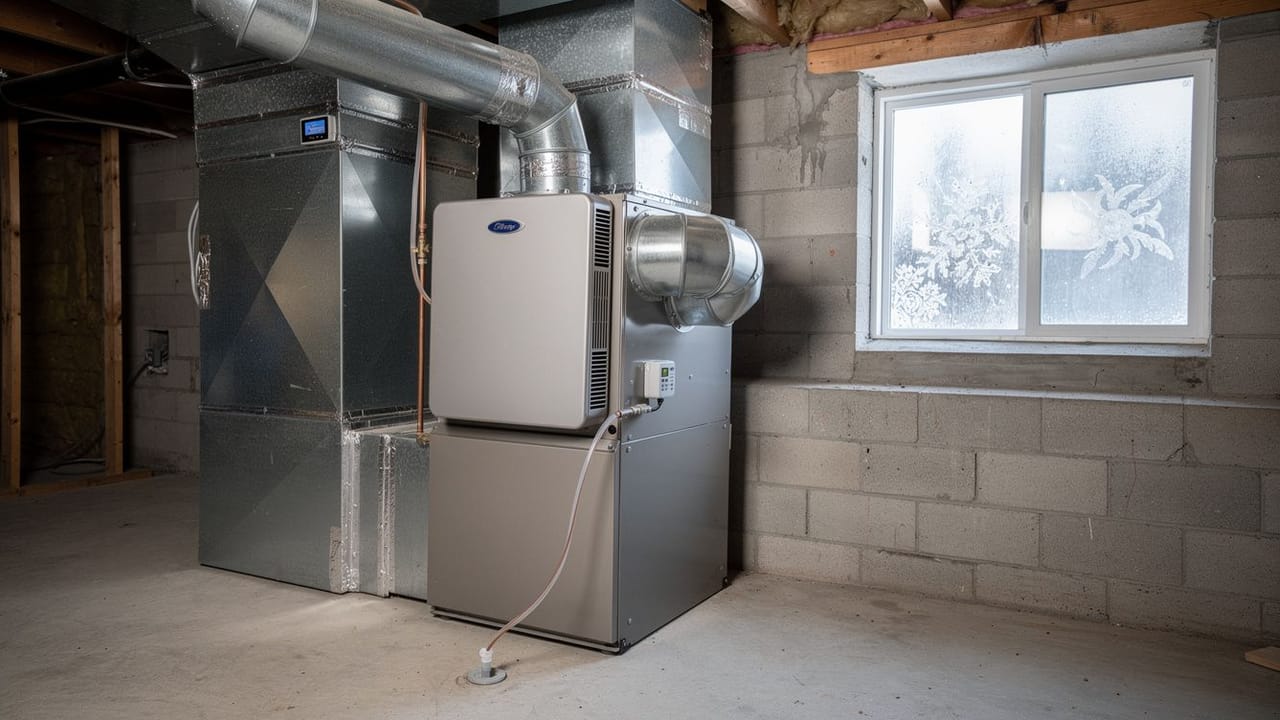
A bypass evaporative humidifier works by evaporation: water runs down over a pad, called a water panel, and heated air from the furnace passes through it and picks up moisture. The Aprilaire manual describes its bypass models drawing air from the supply duct through the panel and into the return, while its fan-powered models push air through with a small fan of their own. Units with a drain send a small steady stream of water away during operation, which carries off most of the minerals.
A heat pump changes the plumbing. Its supply air is not as hot as a gas furnace’s, and the same manual requires a hot water supply, 140°F at most, for heat pump and air handler installations. On a heat pump system in a house that also has a gas water heater close by, that is usually simple. Where the water heater is across the house, we price the line before we price the humidifier.
The control is the other half. An automatic control senses the outdoor temperature and the humidity in the return duct and adjusts itself. A manual one has to be turned down before a cold night, which the manual says to do several hours ahead.
When does a humidifier cause more trouble than it fixes?
When it runs high enough to leave water on cold surfaces. Fog or frost on the inside of the windows is the visible sign; the Aprilaire manual treats it as too much humidity and says to turn the control down a step. EPA’s mold guide reads condensation on windows, walls or pipes the same way.
The part you cannot see is the same moisture reaching the cold side of an exterior wall or the attic, where it can condense out of sight. A house that already runs damp in summer, which our post on why a Nashville house feels clammy at 72 degrees covers, usually needs less help in winter than its owners think.
Before we add a humidifier, we put a hygrometer in the house for a few days. If it already reads above 35 percent through a cold spell, a humidifier is not the fix, and we look for the cause of the dry feeling somewhere else, starting with drafts.
What upkeep does a furnace humidifier need?
A new water panel at least once a year and a look at the parts that hold water. The Aprilaire manual says to replace the panel at least annually, twice a heating season on its smallest drainless model, and to inspect the distribution tray above the panel each year and clear any mineral buildup blocking it. Some digital controls track run time and light up when the panel is due.
At the end of the season, bypass models have a small damper that is closed for summer so cooled air is not pushed through a wet pad, and a manual control is turned off. EPA’s advice for central units is to follow the maker’s cleaning directions and not leave water standing in them.
We fold the humidifier into a maintenance visit in the fall, along with the furnace or heat pump it rides on, and we install new units as part of our ductwork and air quality work. If your house in Franklin or anywhere around Nashville feels dry every winter, ask us to measure it first.
Sources
- U.S. EPA, A Brief Guide to Mold, Moisture and Your Home — Indoor humidity below 60 percent, ideally 30 to 50 percent; condensation on windows, walls or pipes as a sign of high humidity
- U.S. EPA, Use and Care of Home Humidifiers (EPA 402-F-22-002) — Do not humidify above 50 percent; higher humidity encourages dust mites and mold; follow the manufacturer’s directions for central humidifiers
- Aprilaire, Humidifiers Owner’s Manual for Models 350, 360, 400, 400M, 500, 500M, 600, 600M, 700 and 700M — Recommended indoor humidity by outdoor temperature; bypass operation; hot water required for heat pump and air handler applications; water panel replaced at least annually; distribution tray inspection; summer damper
FAQ
Whole-House Humidifiers and Winter Humidity — questions
How much humidity should a house have in the winter?
Usually 30 to 45 percent, lowered as the weather gets colder. EPA says not to humidify above 50 percent, and Aprilaire’s manual recommends 40 percent at 30°F outside and 35 percent at 20°F. A higher setting tends to condense on windows and inside exterior walls before it makes the house noticeably more comfortable.
Does a whole house humidifier cause mold?
It can if it is set too high or left dirty. EPA warns that indoor humidity above 50 percent encourages dust mites and mold, and condensation on windows is a sign the level is too high. A control that lowers the target as the outdoor temperature drops, plus a yearly new water panel, keeps the risk down.
Can a heat pump have a whole-house humidifier?
Yes, but it usually needs a hot water supply. A heat pump’s supply air is cooler than a gas furnace’s, so less water evaporates from the pad, and Aprilaire’s manual requires hot water, 140°F at most, for heat pump and air handler installations. The distance to the water heater often decides the cost.
How often do you change a humidifier water panel?
At least once a year on most furnace humidifiers, and twice a heating season on some smaller drainless models, according to Aprilaire’s owner’s manual. Hard or softened water leaves deposits either way. Some digital controls track run time and light an indicator when the panel is due, which takes the guessing out of it.
Why are my windows fogging with the humidifier on?
Because the setting is higher than the glass can handle at that outdoor temperature. Aprilaire’s manual treats fog or frost on the inside of windows as a sign of too much humidity and says to turn the control down one step. An automatic control does this itself as the weather turns colder.